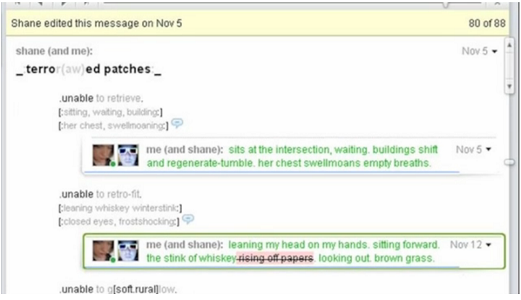
This collaborative work created in the now-defunct Google Wave is documented as a video which shows writing at different stages scrolling up the screen. Each screen-captured image scrolls upwards at a speed that allows readers to apprehend most of the work— less if you’re unfamiliar with mezangelle— visually enacting the wave metaphor. The music for this piece, “Something Happened When You Were Born” by minusbaby, contributes to a sense of collaborative building through its aural structure, visualized below.
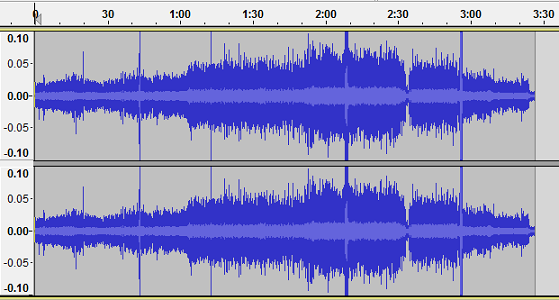 Judging by the shape of the sound waves (get it?), this instrumental piece has a relatively simple structure: a slow crescendo in volume and electronica elements (lasting about 2:30 minutes) with a shorter (about 1:00 minute) diminuendo. This structure can be mapped with the visual collaboration we can see in the waves of Wave interactions, mirroring the intensification of interactions between Breeze and Hinton as they shape their work and a reduction of activity as they tweak it into final form. Would we be able to visualize the interaction if they simply published the final version as a printable text?
Not really. And that is one of the points of this work. The traditional representation of works as a static printable or displayable document favors the final version, flattening potentially lengthy processes into a single moment in time: that of publication. Textual scholars who seek to represent multiple versions of works go to great lengths to do so, via footnotes, variorum editions, digital archives, or fluid-text editions.
Google Wave implemented a metaphorical interface to visualize workflows over time, moving away from the page as metaphorical interface, as we see in “track changes” functionality in Microsoft Word. There are many other online collaboration tools: some become well established, others come and go as Google Wave did.
Keep this in mind as you watch and read this collaborative work and experience how its poetic compression and decompression happens in the time and space between Breeze and Hinton.
Judging by the shape of the sound waves (get it?), this instrumental piece has a relatively simple structure: a slow crescendo in volume and electronica elements (lasting about 2:30 minutes) with a shorter (about 1:00 minute) diminuendo. This structure can be mapped with the visual collaboration we can see in the waves of Wave interactions, mirroring the intensification of interactions between Breeze and Hinton as they shape their work and a reduction of activity as they tweak it into final form. Would we be able to visualize the interaction if they simply published the final version as a printable text?
Not really. And that is one of the points of this work. The traditional representation of works as a static printable or displayable document favors the final version, flattening potentially lengthy processes into a single moment in time: that of publication. Textual scholars who seek to represent multiple versions of works go to great lengths to do so, via footnotes, variorum editions, digital archives, or fluid-text editions.
Google Wave implemented a metaphorical interface to visualize workflows over time, moving away from the page as metaphorical interface, as we see in “track changes” functionality in Microsoft Word. There are many other online collaboration tools: some become well established, others come and go as Google Wave did.
Keep this in mind as you watch and read this collaborative work and experience how its poetic compression and decompression happens in the time and space between Breeze and Hinton.
Featured in ELO 2012 Media Art Show
Judging by the shape of the sound waves (get it?), this instrumental piece has a relatively simple structure: a slow crescendo in volume and electronica elements (lasting about 2:30 minutes) with a shorter (about 1:00 minute) diminuendo. This structure can be mapped with the visual collaboration we can see in the waves of Wave interactions, mirroring the intensification of interactions between Breeze and Hinton as they shape their work and a reduction of activity as they tweak it into final form. Would we be able to visualize the interaction if they simply published the final version as a printable text?
Not really. And that is one of the points of this work. The traditional representation of works as a static printable or displayable document favors the final version, flattening potentially lengthy processes into a single moment in time: that of publication. Textual scholars who seek to represent multiple versions of works go to great lengths to do so, via footnotes, variorum editions, digital archives, or fluid-text editions.
Google Wave implemented a metaphorical interface to visualize workflows over time, moving away from the page as metaphorical interface, as we see in “track changes” functionality in Microsoft Word. There are many other online collaboration tools: some become well established, others come and go as Google Wave did.
Keep this in mind as you watch and read this collaborative work and experience how its poetic compression and decompression happens in the time and space between Breeze and Hinton.
Featured in ELO 2012 Media Art Show