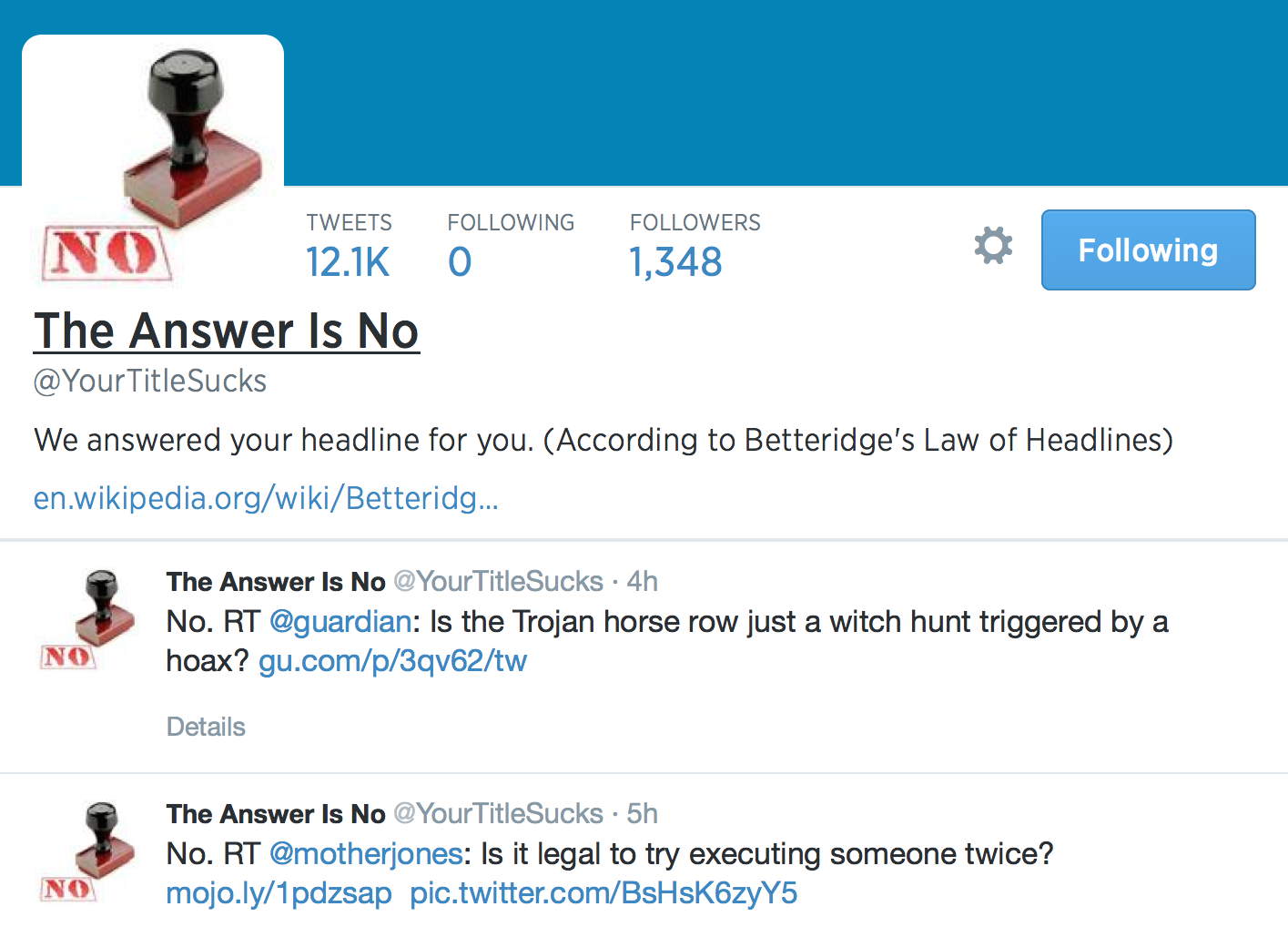
This bot tirelessly applies a principle described by Betteridge's law of headlines, which states that "Any headline which ends in a question mark can be answered by the word no." This has become a kind of litmus test for sloppy and sensationalist journalism, and the bot relentlessly applies by detecting question headlines in Twitter by newspapers, magazines, and journals and retweeting the headline with the answer: "No." Or in Eppink's words:



Reading these articles reveals that the answer is indeed no, or that there isn't enough data to provide one, yet the article simply seeks to attract attention. Is it 100% accurate? No. But it is right often enough to train you think before you click.
Featured in: Genre: Bot
The Answer Is No serves a public purpose by watching Twitter for instances of journalistic uncertainty and answering them for the benefit of the publication and its readers.Whenever we access websites, newsfeeds, or social networks, we are exposed to material designed to capture our attention, materialized by a much sought-after click that leads deeper into attention grabbing material. In print-based journalism, this developed into the convention of the headline, which could command attention of people walking by a newsstand. This basic tool from print media has ported nicely to the Web, but as online advertising models have emerged to reward numbers of site visits, headlines have been sensationalized to become what is known as clickbait. For an analysis and examples of manipulative uses of headlines, read Michael Reid Roberts' article on the rhetoric of clickbait as seen in sites like Upworthy and BuzzFeed. A response from community members is the creation of Twitter accounts dedicated to fighting clickbait. This article discusses how @HuffPoSpoilers and @SavedYouAClick are two examples of accounts that crusade against this increasingly commonplace and irritating practice. And while these are human-powered efforts and can therefore provide more versatility in their output, there's something fascinating about a principle that can be reduced into a simple algorithm and executed endlessly by a bot. "The Answer is No" immunizes its followers from a cheap rhetorical ploy by reminding them of Betteridge's law and offering examples of question headlines, all responded to with the computational equivalent of a rubber stamp, as can be seen below:
Reading these articles reveals that the answer is indeed no, or that there isn't enough data to provide one, yet the article simply seeks to attract attention. Is it 100% accurate? No. But it is right often enough to train you think before you click.
Featured in: Genre: Bot