This is part 5 of a series of 5 postings on poems generated by the “Frequency” program. For an overview of the series, read the first entry.
The exercise of creating a data set based on Oulipian constraints and creating array and mechanisms to generate certain pre-existent forms, laid the groundwork for Rettberg to be inspired to create three forms: Doubling (discussed in the previous entry), Four Square, and Two Towers. The two latter forms were powered by three of the Machine’s capabilities: the ability to count characters in a line (including spaces), use that information to generate arrays and poems, and use a fixed-width font (Courier). This gives Rettberg pictorial control over text, allowing him to create relations between lines of the same string length and cluster them accordingly to create stanzas.
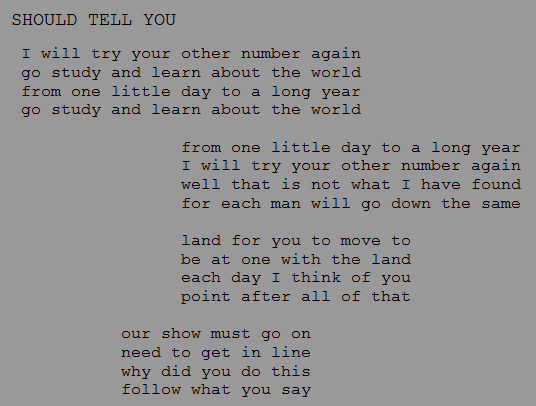
The Four Square poem depicted above has four four-line stanzas selected by character length, rather than by the more traditional methods, such as metrical feet, rhyme, or syllable count. Because they are generated from an automated array it doesn’t really show how many lines fit a particular character count. This may account for some of the line repetition in the first two stanzas, which lends the poem a refrain-like musicality. Their indentation, another variable, provide added interest in the stanzas’ spatial relations. Are the two central stanzas embedded within an idea expressed in the first and last stanzas? And why is the last one more indented than the first?
The moment we start asking why, we come to the question of intent— why Rettberg made certain choices. If you seek a satisfactory answer you have to resist the urge to state that these particular indentations and choices are meaningless because they, like much about this poem, are randomly generated. These poems aren’t merely Turing tests, attempting to fool readers into projecting a false authorship onto them (though I wouldn’t put it past Rettberg). A more productive approach is to think why Rettberg made the choices he made, including the choice to leave some decisions in the hands of his collaborator, the machine. And his intentions are encoded into those processes. As for the stanza indentation is concerned, I think he placed it there to suggest alternate relations between stanzas than the single train of thought one usually gets when reading a traditionally formatted sequence of stanzas.
The Two Towers poems generate two character-based stanzas next to each other that add up to 40 characters, as can be seen in this random example:
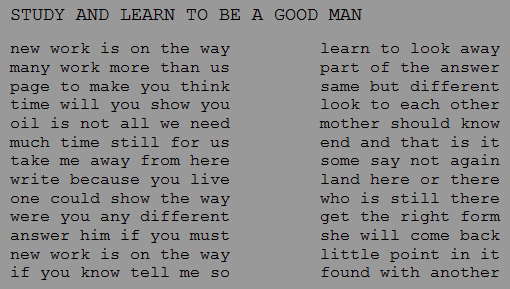 This form presents multiple ways of reading these stanzas: individually, sequentially, or line by line (across the divide) to form new line combinations, call and response situations, and the juxtaposed voices of two different kinds of lines.
It is probably something he might not have come up with, had he not embarked upon the “Frequency” project. Here we witness digital poiesis— a true collaboration between Rettberg and the Machine.
This form presents multiple ways of reading these stanzas: individually, sequentially, or line by line (across the divide) to form new line combinations, call and response situations, and the juxtaposed voices of two different kinds of lines.
It is probably something he might not have come up with, had he not embarked upon the “Frequency” project. Here we witness digital poiesis— a true collaboration between Rettberg and the Machine.
Featured in: The Frequency Series
This form presents multiple ways of reading these stanzas: individually, sequentially, or line by line (across the divide) to form new line combinations, call and response situations, and the juxtaposed voices of two different kinds of lines.
It is probably something he might not have come up with, had he not embarked upon the “Frequency” project. Here we witness digital poiesis— a true collaboration between Rettberg and the Machine.
Featured in: The Frequency Series