This is part 4 of a series of 5 postings on poems generated by the “Frequency” program. For an overview of the series, read the first entry.
This entire project was inspired by the OULIPO, and how they created new poetic and literary forms based on mathematical and other constraints. Not only did they create a great number of fascinating constraints— such as the n+7, the snowball, and all manner of permutational works— they also helped us rethink traditional poetic forms as constraints that led to creativity. From this perspective, a sonnet or a haiku are little rhetorical machines, and to write one is to shape’s one’s thoughts and language choices to capitalize upon their affordances and constraints.The poems focused on in this entry are inspired by the Oulipian snowball, a poem based on the constraint of increasing the number of words, syllables, or letters per line. True to their methods, Oulipians also inverted the snowball (the melting snowball), and combined the two types, producing expanding and contracting lines, and hourglass-shaped poems with a visual and rhetorical shape in the same tradition as George Herbert’s “Easter Wings.”Rettberg describes three kinds of snowball poems— by word, by syllable, and by character— and does the groundwork for all three in the Ruby program, but chose to publish only the word and character snowball poems, leaving the syllable counts to inform an original variation on the concept: the doubling. Let’s briefly examine all three to see how their rhetoric unfolds.
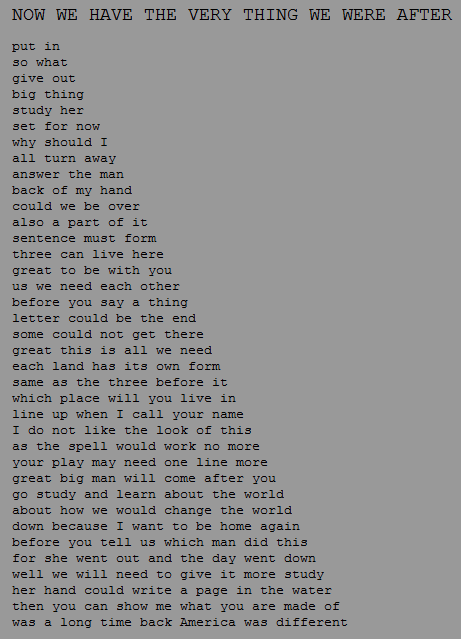 A whopping 36 lines in length, this poem builds more through visual accumulation than by meaning, though it helps to note that there are very few variants in the lengthier line level. It’s as if the poem was building toward one of the two final lines, which makes a strong last impression for the reader to think about the poem, even if the middle text doesn’t.
The doubling poem presents increments in which the number of syllables per line doubles until reaching 8 syllables, and then it divides itself by two until it ends. It is almost like an accelerated losange snowball or one which has been processed by a lossy compression algorithm that accentuates its rhetorical urgency.
A whopping 36 lines in length, this poem builds more through visual accumulation than by meaning, though it helps to note that there are very few variants in the lengthier line level. It’s as if the poem was building toward one of the two final lines, which makes a strong last impression for the reader to think about the poem, even if the middle text doesn’t.
The doubling poem presents increments in which the number of syllables per line doubles until reaching 8 syllables, and then it divides itself by two until it ends. It is almost like an accelerated losange snowball or one which has been processed by a lossy compression algorithm that accentuates its rhetorical urgency.
Featured in: The "Frequency" Series
ALSO BE WELL any how them or us air water and land back where we come from when will we be through with this it could come from water or the air he will be old and with time will follow way to make her see me for what I am at the time he could still learn a thing or two at this place we would try to make a go of itThis random sampling from the snowball by word only has 10 lines, which build a strong sense of progression without straining the reader’s train of thought. The thematic focus on human relationships is strengthened by the use of a speaker addressing his/her partner. Different from the tanka, which had syllable constraints that kept their lines short, here we get the benefit of seeing how more complex relationship issues find expression in longer lines. The random sample of a snowball by character has been quoted via an image because the style sheet for this blog would change the font from Courier to a variable width font, ruining its visual effect.
A whopping 36 lines in length, this poem builds more through visual accumulation than by meaning, though it helps to note that there are very few variants in the lengthier line level. It’s as if the poem was building toward one of the two final lines, which makes a strong last impression for the reader to think about the poem, even if the middle text doesn’t.
The doubling poem presents increments in which the number of syllables per line doubles until reaching 8 syllables, and then it divides itself by two until it ends. It is almost like an accelerated losange snowball or one which has been processed by a lossy compression algorithm that accentuates its rhetorical urgency.
AFTER WHAT YOU SAID even out where is your place because we are so different the water came and went through us off to try again even ifThe troubled relationships that are such a clear motif in the “Frequency” poems find powerful expression in this form, capturing a moment of crisis in this randomly sampled poem. The open ended endings in this and other poems leave things unresolved, perhaps ripe for another episodic tension in the relationship. This series of Oulipian inspired poems expose the impact of line length in poetic expression, particularly because so many of the variables (like word choice) are controlled in this experiment.
Featured in: The "Frequency" Series