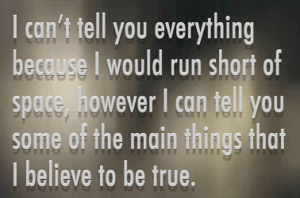
This poem has a very clear voice, an “I” whose beliefs are expressed throughout this work, which some readers may interpret as William Poundstone’s (or at least a persona he has created). From the outset, however, Poundstone explains that this poem was created from searches of the words “I believe” with various online engines, and that “Some texts have been recombined using a travesty algorithm.” He also provides a long list of people quoted for this poem in the page titled “Huh?” This subverts the notion of a single voice by acknowledging the multiplicity of sources and people quoted and the transformations potentially applied to the texts.
So who writes this?
Multiple algorithms have gone into the composition of this poem, not least of which is the one known as Travesty. This algorithm was made famous in 1984 by literary critic Hugh Kenner and programmer Joseph O’Rourke who published “A Travesty Generator for Micros” in Byte magazine— a Pascal program to implement it and a brief essay on language statistics leading to a fascinating question: “to what degree can personal ‘style’ be described as a manifestation of letter frequencies?” This engine is a kind of analytical tool, taking a text and producing a travesty of it, that is “a literary or artistic composition so inferior in quality as to be merely a grotesque imitation of its model.” But it’s an interesting imitation, according to Kenner, and one that provides insights on style.
Poundstone uses the method to transform some of the texts and to cast doubt on the quotes used. Because the lines are not directly attributed, we can only guess their provenance, and that identification is further complicated because we don’t know what has been quoted faithfully and what has been transformed. Then again, someone had to choose the lines— found or generated— and we might as well call that persona the speaker of the poem.
So from a multiplicity of spoken and written texts filtered through computer and human algorithms we get an “I” that believes certain truths. Is Poundstone creating or subverting a lyric voice in this poem?
Note: Thanks to Mark Sample for finding me a scanned copy of the Byte article.