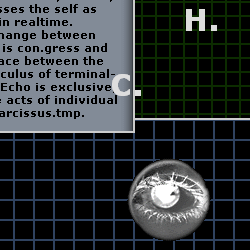
This celebrated work of e-literature is not only hard to label— poetry, fiction, theory, essay, English, code— it is also hard to read. This is not a criticism of the text: it is merely an observation on its ontological reality.
When Memmott wrote it in 2000, DHTML was a new thing, without established standards, and a key player in the browser wars. Aware of the difficulties in maintaining compatibility over time, he engaged its obsolescence thematically in the work. Nowadays, DHTML has come a long way towards becoming a new open standard, but the code in “Lexia to Perplexia” barely functions in modern browsers.
What can an interested reader do to experience more than the tip of the iceberg that is still functional in this text?
Featured in The Electronic Literature Collection, Volume 1.
- Get an old browser: any Netscape 4.x or Internet Explorer 4.x will do… if you can get it to work in your current operating system.
- Access the source code (a right click should give you the option) and read its linguistic texts, open its links to images, and try to reconstruct a functioning version in your head (understanding JavaScript helps).
- Read about it: N. Katherine Hayles performs a deft reading of it in EBR, highlighting how this work interpellates us as cyborgs. (For more about how we are all cyborg readers of electronic literature, read the section “The Cyborg Reader” in my dissertation (pgs. 67-71).)
Featured in The Electronic Literature Collection, Volume 1.