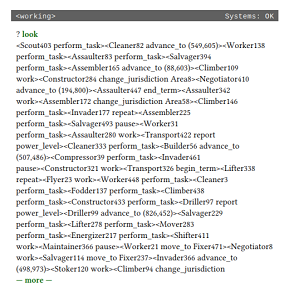
This is a work of poetic narrative built upon the structure of interactive fiction. The protagonist of this piece is a defective (“bad”) machine whose malfunction has given it self awareness and independence from the clockwork functioning of a warehouse full of robots. The reader (player, interactor) is placed in this machine’s position and must learn how to survive in a world that will quickly take it apart and reabsorb it into its operational structure. The most poetic part of this work is that the lessons are in interpreting its language and interacting with the parser, both of which lead to a fresh experience of language as action and power. Using the imperative form reminds us of how powerful words can be to command a person or machine into action, much like computers follow programmed commands… provided they can parse the instructions and that they’re not defective. The shift in perspective offered by this “bad machine” is another way in which experience is made fresh, much as the Martian Poets did with their poetry.
Nick Montfort’s review of this work aligns it with Anglo Saxon riddles and William Carlos Williams’ famous description of a poem as “a small (or large) machine made of words.” Montfort concludes that “those looking for electronic literature with the intricacy of an involved novel or long poem would do well to fire up Dan Shiovitz’s dazzling, intricate, and highly relevant riddle.”
I couldn’t agree more.
Note: The link in Poems that Go isn’t working properly, but I included the link because it has an insightful introduction by Shiovitz. For a functioning copy and the software needed to install it, I recommend the link in the Electronic Literature Collection, Volume 1.
Featured in Electronic Literature Collection, Volume 1, Poems That GO.
Featured in Electronic Literature Collection, Volume 1, Poems That GO.