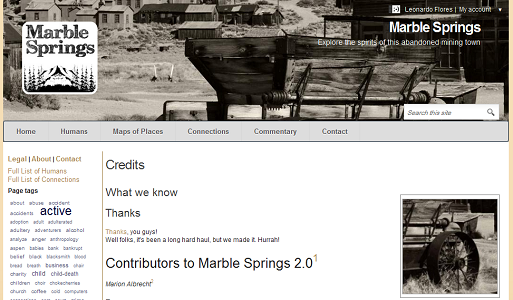
This hypertext poem is open by design, with a long history of inviting participation from others. When it was first published in 1993 in HyperCard format by Eastgate systems (referred to in earlier entries as Marble Springs 1.0) it offered readers the ability to contribute their own writing to the work via annotations, as described in the publisher’s site.
 This “Note from somewhere else” affirms her authority while accommodating others to contribute to it, not because she needed it, but because perhaps her readers needed to “shape their own place of refuge.” Seen from this perspective, Marble Springs isn’t just a work, but a place in Larsen’s imagination that has been made available for others to visit. But as decades of fandom and fanfiction have shown us, people have a need to return to fictional spaces, such as the Star Wars, Star Trek, Harry Potter, Marvel or DC comics universes. So she empowered readers/visitors of this fictional town who wish to explore their own issues by expanding narratives or imagining other moments of lyric intensity in this town. And the really dedicated ones, “who heroically went through a byzantine copyright process to add their works officially,” are now credited and incorporated, and their contributions live on in the work.
Deena Larsen has kept Marble Springs open by implementing it in a wiki— and the registration process and ability to create and edit pages are wide open. As the administrator, she retains the power to roll back changes to earlier versions if she doesn’t approve, and can ban abusive users from making changes, reaffirming her authorial power. Still, this presents a tremendous opportunity for collaborative creation, as many contributors already have. As developed and populated as this town has been for several generations, so many characters are simply sketches, or as I like to think of them: narrative placeholders.Visit the “Directory of Humans” and you’ll see that she has written poems about half of the 195 characters, and mostly the women because “they took [her] in and understood [her] outbursts.”
There are so many connections to explore and extend, places to map out, stories to tell.This space is ripe for a netprov— one that arises from an understanding of this place, its inhabitants, history, and ecology. Or perhaps a solo performance of someone whose soul feels at home here, and can quietly chip away at an uncarved corner of Marble Springs.
This “Note from somewhere else” affirms her authority while accommodating others to contribute to it, not because she needed it, but because perhaps her readers needed to “shape their own place of refuge.” Seen from this perspective, Marble Springs isn’t just a work, but a place in Larsen’s imagination that has been made available for others to visit. But as decades of fandom and fanfiction have shown us, people have a need to return to fictional spaces, such as the Star Wars, Star Trek, Harry Potter, Marvel or DC comics universes. So she empowered readers/visitors of this fictional town who wish to explore their own issues by expanding narratives or imagining other moments of lyric intensity in this town. And the really dedicated ones, “who heroically went through a byzantine copyright process to add their works officially,” are now credited and incorporated, and their contributions live on in the work.
Deena Larsen has kept Marble Springs open by implementing it in a wiki— and the registration process and ability to create and edit pages are wide open. As the administrator, she retains the power to roll back changes to earlier versions if she doesn’t approve, and can ban abusive users from making changes, reaffirming her authorial power. Still, this presents a tremendous opportunity for collaborative creation, as many contributors already have. As developed and populated as this town has been for several generations, so many characters are simply sketches, or as I like to think of them: narrative placeholders.Visit the “Directory of Humans” and you’ll see that she has written poems about half of the 195 characters, and mostly the women because “they took [her] in and understood [her] outbursts.”
There are so many connections to explore and extend, places to map out, stories to tell.This space is ripe for a netprov— one that arises from an understanding of this place, its inhabitants, history, and ecology. Or perhaps a solo performance of someone whose soul feels at home here, and can quietly chip away at an uncarved corner of Marble Springs.
Marble Springs joins reading and writing as it invites each reader to rewrite and extend the work. Open or “constructive hypertexts” have long been considered one of the great promises of hypertext fiction and of the colonization of cyberspace, yet actually creating an open hypertext, one in which others can write and will wish to write, poses both technical and artistic challenges which Larsen has met head-on.And write they did, and submitted their contributions to Eastgate Systems. As listed in the credits page for Marble Springs 3.0 (linked to in the title). When referring to reader contributions in Marble Springs 2.0 in the About page, Larsen explains:
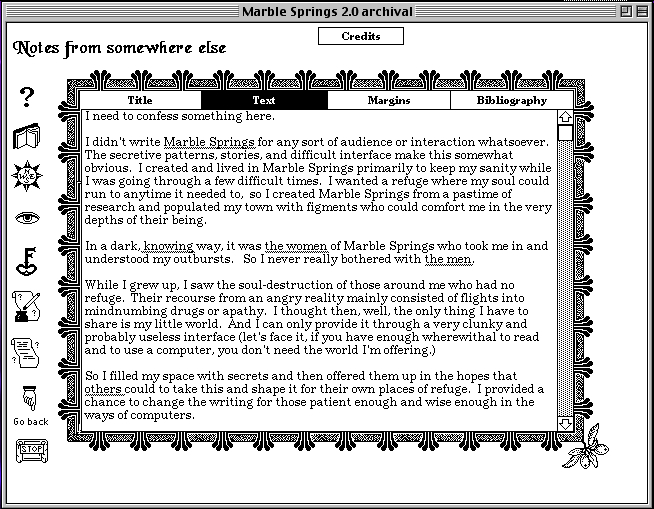
Readers did move into the town, interacting with the characters. They reshaped what they needed to. Which was what I had —in this brave new world of hypertexts, experiments, and collaboration — declared I wanted. In the later 1990s, when HyperCard looked to be coming back from the dead, Mark Bernstein asked me to make good on my promises and create a new edition to actually put these writings in. So I redesigned and reprogrammed Marble Springs 2.02 in HyperCard to show that an open collaborative hypertext could work and point the way to “the future of constructive hyperfiction” and rewrote to incorporate people’s contributions. HyperCard was finally buried (but still alive, still kicking). Marble Springs 2.0 has never been made available.Judging from this entry, it seems Larsen had ambivalent desires to incorporate other people’s writings into this very personal project. If you follow the link to “declared what I wanted” above, it leads to a “Confessions” page: a hidden node in the 2.0 version depicted below:
This “Note from somewhere else” affirms her authority while accommodating others to contribute to it, not because she needed it, but because perhaps her readers needed to “shape their own place of refuge.” Seen from this perspective, Marble Springs isn’t just a work, but a place in Larsen’s imagination that has been made available for others to visit. But as decades of fandom and fanfiction have shown us, people have a need to return to fictional spaces, such as the Star Wars, Star Trek, Harry Potter, Marvel or DC comics universes. So she empowered readers/visitors of this fictional town who wish to explore their own issues by expanding narratives or imagining other moments of lyric intensity in this town. And the really dedicated ones, “who heroically went through a byzantine copyright process to add their works officially,” are now credited and incorporated, and their contributions live on in the work.
Deena Larsen has kept Marble Springs open by implementing it in a wiki— and the registration process and ability to create and edit pages are wide open. As the administrator, she retains the power to roll back changes to earlier versions if she doesn’t approve, and can ban abusive users from making changes, reaffirming her authorial power. Still, this presents a tremendous opportunity for collaborative creation, as many contributors already have. As developed and populated as this town has been for several generations, so many characters are simply sketches, or as I like to think of them: narrative placeholders.Visit the “Directory of Humans” and you’ll see that she has written poems about half of the 195 characters, and mostly the women because “they took [her] in and understood [her] outbursts.”
There are so many connections to explore and extend, places to map out, stories to tell.This space is ripe for a netprov— one that arises from an understanding of this place, its inhabitants, history, and ecology. Or perhaps a solo performance of someone whose soul feels at home here, and can quietly chip away at an uncarved corner of Marble Springs.