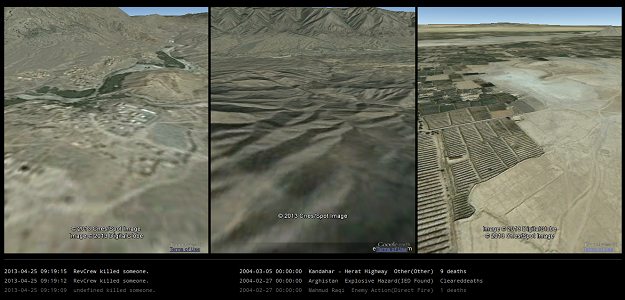
This poetic Internet artwork makes a visceral connection between the documentation of frags in Counter-Strike multiplayer servers and the military actions documented in the Wikileaks Afghan War Diary database. As it connects the fake videogame death to military actions that usually resulted in the loss of one or many real human lives, it performs Google Earth searches to display the location of these actions. By presenting three events and locations at a time, it allows for the visuals to load and creates a time buffer to allow us to focus our attention on a particular location for longer than the few seconds between frags allow. And since we are unable to control anything in this piece, except the choice of server at the beginning, we become powerless spectators of violence made abstract through terse language and eerie landscapes devoid of human beings.
 There is a poetic quality to the simply structured constrained language in the Counter-Strike logs and military reports. Some logs don’t display user identities, producing phrases reminiscent of E. E. Cummings, such as “undefined killed someone.” This simplicity reads vertically as a kind of refrain, a violent tercet which makes the Afghan War Diary reports stand out for their rich detail. Read them aloud to appreciate how the juxtaposition brings out the violence in a piece at a poetic level through repetition and variation, rhythms and rhyme.
And think about what isn’t being said about each event, all the missing details, context, imagery, and stories that aren’t being told in reports that become pure data, dehumanized like these empty landscapes in Google Earth.
There is a poetic quality to the simply structured constrained language in the Counter-Strike logs and military reports. Some logs don’t display user identities, producing phrases reminiscent of E. E. Cummings, such as “undefined killed someone.” This simplicity reads vertically as a kind of refrain, a violent tercet which makes the Afghan War Diary reports stand out for their rich detail. Read them aloud to appreciate how the juxtaposition brings out the violence in a piece at a poetic level through repetition and variation, rhythms and rhyme.
And think about what isn’t being said about each event, all the missing details, context, imagery, and stories that aren’t being told in reports that become pure data, dehumanized like these empty landscapes in Google Earth.
There is a poetic quality to the simply structured constrained language in the Counter-Strike logs and military reports. Some logs don’t display user identities, producing phrases reminiscent of E. E. Cummings, such as “undefined killed someone.” This simplicity reads vertically as a kind of refrain, a violent tercet which makes the Afghan War Diary reports stand out for their rich detail. Read them aloud to appreciate how the juxtaposition brings out the violence in a piece at a poetic level through repetition and variation, rhythms and rhyme.
And think about what isn’t being said about each event, all the missing details, context, imagery, and stories that aren’t being told in reports that become pure data, dehumanized like these empty landscapes in Google Earth.