This is part 3 of a series of 5 postings on poems generated by the “Frequency” program. For an overview of the series, visit the first entry.
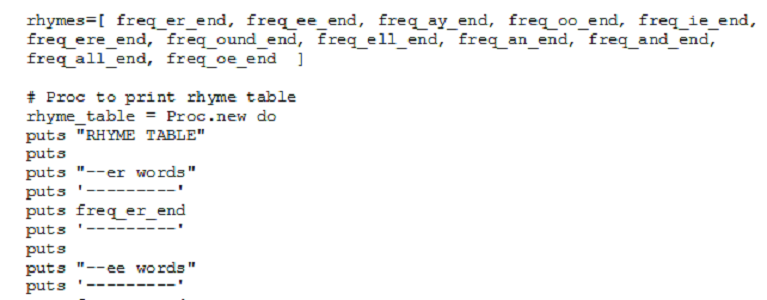
The terza rima and sonnets generated by the “Frequency” program have two main challenges: coherence over a greater number of lines and the rhetorical expectations that come with the form. The easiest part of all this is rhyme, since Rettberg created 12 arrays according to line endings and up to 7 rhyming variables that draw from them to create poems with the necessary rhyme schemes..Terza rima, as a set of three line stanzas with an ABA BCB CDC DED rhyme scheme, is therefore simple to assemble. The problem is that this poetic form creates momentum by including within each tercet the key to the next tercet— and the ear craves the completion of the rhyme. It is therefore understandable that Dante created this form for his lengthy narrative poem The Divine Comedy. Let’s see one of Rettberg’s poems.
Featured in: The "Frequency" Series
LIKE A MAN FROM A DIFFERENT WORLD play as if you know two were here before you think back long as you can go place it where you want to we need a hand great to be with you form a new land long was the day from water to land people get out of the way why ask me of these people what can we sayThe poem is surprisingly coherent, particularly when the generator fills the rhyme with a line that ends with the same word, as is the case with the third stanza. Perhaps the result is a fortunate one that works well conceptually from the title to the last line, describing a man who wishes to live in isolation, building a land to get away from people. Perhaps we are willing to create short causal chains, particularly when the lines make such recursive use of common words. Sonnets are trickier because while their rhyme schemes are simple to replicate, the rhetorical progression is more difficult, particularly the volta. In the Petrarchan sonnet, the first 8 lines are meant to present an idea with the 9th line offering a sharp rhetorical turn that is explored in the remaning 5 lines. A random one should provide some insight.
AWAY FROM ME on her need would he try his kind hand said way out there man way out there man place the letter in my hand and you move through the land sentence the boy as a man word as the work of man or we could set out for a new land name all who you know like you were in me there will come a day her look was such that he would not know answer me they take our people awayDoes the rhyme scheme seem a bit too repetitive? I suspect the program randomly chose two similar rhymes and churned out a poem that creates an inadvertent volta just from the pleasure of getting away from the rhyme in the first eight lines, though its repetition of words does help keep the lines conceptually focused. Will this work with the Spenserian sonnet and its interlocking rhyme scheme closed by a couplet?
THINK ABOUT WHAT YOU TRY TO DO TO ME find another to give it to you why ask me most of all I need you would you like to see follow me word as the work of man thing that you can tell me study and learn to be a good man word as the work of man read him the letter he will help when he can answer my letter first there is a sound has he been aroundThe rhyme scheme across stanzas build momentum much like terza rima, with repetitiveness creating conceptual bridges with rhymes that might make you want to jump off from them. The selection algorithm prevents accidental rhyme repetition, so the couplet at the end at least offers a refreshing rhyme variation, if not necessarily a volta. The Shakespearean sonnet… wait a minute, Rettberg didn’t publish any in “Frequency.” But he did design the program with that famous type in mind:
- He wrote only 7 rhyme variables: just enough to to get to the Shakespearean GG couplet. And he only gets as far as using E rhymes in the generated poems.
- He wrote a subroutine to produce them, readable in the Ruby program below:
Why didn’t he generate them? Is it because his lines aren’t in iambic pentameter and they wouldn’t sound like a sonnet? Is the constraint of posing an idea that gets elaborated with a minor volta and a couplet that transforms the whole poem too much to leave to chance? Was the Bard’s name too much of a reminder of the richness of his vocabulary versus the “base units of language” displayed here? Perhaps it’s better to add some sonnets into the mix, but not so many that the reader tires of them. A little sonnet goes a long way, and this experiment seems to be more successful at shorter and simpler pieces.shakespearian = Proc.new do puts ‘———————————————————’ puts frequency[rand(200)][rand(10)].upcase puts puts A[rand(A.length)] puts ’ ’ + B[rand(B.length)] puts ’ ’ + B[rand(B.length)] puts ’ ’ + A[rand(A.length)] puts C[rand(C.length)] puts ’ ’ + D[rand(D.length)] puts ’ ’ + D[rand(D.length)] puts ’ ’ + C[rand(C.length)] puts E[rand(E.length)] puts ’ ’ + F[rand(F.length)] puts ’ ’ + F[rand(F.length)] puts ’ ’ + E[rand(E.length)] puts G[rand(G.length)] puts G[rand(G.length)] puts ‘———————————————————’ end
Featured in: The "Frequency" Series