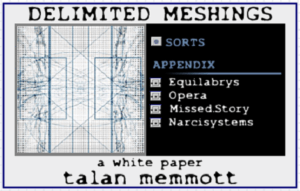
This hypertext work of poetry, theory, and narrative is exquisitely programmed in HTML 3.2 using JavaScript from 12 years ago, which means that it is currently best read in Internet Explorer, which retains its responsive elements. This DHTML piece uses JavaScript to modify the Document Object Model (DOM), which means that the document is the same, but once you activate certain parts of it, its rendering becomes modified with the addition of static or kinetic elements.
Memmott uses it in this poem to create layers of visual and textual information that is revealed as the reader interacts with different prompts. For example, the section titled “Sorts” allows for the reader to reveal texts by clicking on different parts of the image, seen below.
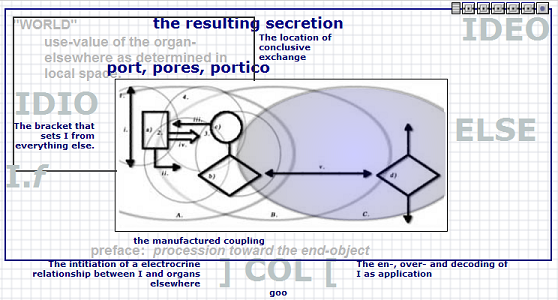 As the reader clicks on the spaces offered, portions of the text emerge in different parts of the screen, which allows linguistic (the words), graphical (their size and relative position in the page), and logical (by their trigger points in the flowchart & Venn diagram) readings.
In other parts, such as “Equilabrys,” he uses links to trigger link/variables within the text that graphically point or circle what they may be referring to (see below):
As the reader clicks on the spaces offered, portions of the text emerge in different parts of the screen, which allows linguistic (the words), graphical (their size and relative position in the page), and logical (by their trigger points in the flowchart & Venn diagram) readings.
In other parts, such as “Equilabrys,” he uses links to trigger link/variables within the text that graphically point or circle what they may be referring to (see below):
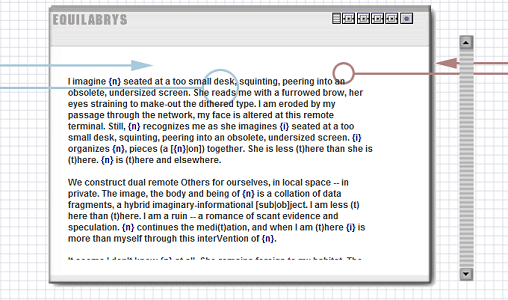 Reading this text requires reading all of its layers and demarcations, as well as its meaning bifurcations. Note the use of words like “medi(t)ation” and “(t)here.” Do you read them as “mediation” and “here” or “meditation” and “there?” I suggest reading the sentences both ways to see how the word choices affect meaning— effectively executing a graphical script in your mind.
As you read this executable text and unpack its densely theoretical and poetic language, don’t be put out by the occasional error message in your mind. Its pleasures are text(ur)al.
Reading this text requires reading all of its layers and demarcations, as well as its meaning bifurcations. Note the use of words like “medi(t)ation” and “(t)here.” Do you read them as “mediation” and “here” or “meditation” and “there?” I suggest reading the sentences both ways to see how the word choices affect meaning— effectively executing a graphical script in your mind.
As you read this executable text and unpack its densely theoretical and poetic language, don’t be put out by the occasional error message in your mind. Its pleasures are text(ur)al.
Featured in Cauldron & Net.
As the reader clicks on the spaces offered, portions of the text emerge in different parts of the screen, which allows linguistic (the words), graphical (their size and relative position in the page), and logical (by their trigger points in the flowchart & Venn diagram) readings.
In other parts, such as “Equilabrys,” he uses links to trigger link/variables within the text that graphically point or circle what they may be referring to (see below):
Reading this text requires reading all of its layers and demarcations, as well as its meaning bifurcations. Note the use of words like “medi(t)ation” and “(t)here.” Do you read them as “mediation” and “here” or “meditation” and “there?” I suggest reading the sentences both ways to see how the word choices affect meaning— effectively executing a graphical script in your mind.
As you read this executable text and unpack its densely theoretical and poetic language, don’t be put out by the occasional error message in your mind. Its pleasures are text(ur)al.
Featured in Cauldron & Net.