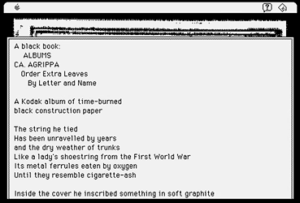
Agrippa: A Book of the Dead (1992) is the first high-profile electronic poem, in part because it was written by William Gibson, a novelist famous for imagining cyberspace in the 1980s, in part because of its production as an electronic object and artist’s book. The link provided leads to a site titled “The Agrippa Files” created by The Transcription Project at UC Santa Barbara, which documents the material, cultural, and computational conditions that make this poem such a fascinating work. For those new to this work, I recommend the following posting, which introduces the poem and resources assembled in the site.
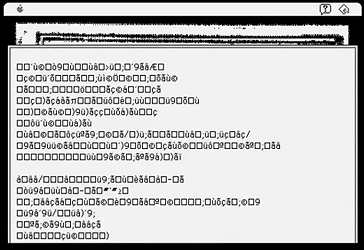
In a nutshell, this e-poem was programmed to display the text scrolling down the screen once (like a video but without controls), and then encrypt the program so it could never be played again, effectively self-destructing. Here is an image of the last part of the poem, after it is done displaying the text of the poem. Is this an image of the text being encrypted?
 The poem was hacked and posted online the day after it was presented to the public (read Matt Kirschenbaum’s account) and it has been available online ever since, enjoying the status of a cult literary object.
But was it really hacked?
Not really:
The poem was hacked and posted online the day after it was presented to the public (read Matt Kirschenbaum’s account) and it has been available online ever since, enjoying the status of a cult literary object.
But was it really hacked?
Not really:
Read more about this work at: ELMCIP
The poem was hacked and posted online the day after it was presented to the public (read Matt Kirschenbaum’s account) and it has been available online ever since, enjoying the status of a cult literary object.
But was it really hacked?
Not really:
- Agrippa’s linguistic text was made available online and William Gibson eventually published a version of the poem (containing the same linguistic text as found in the disk) in his website in 2003. But that is only part of the information of the text. What happens to the visual information of the text, such as font, font size, line spacing, and so on? How do you communicate the experience of the window size, the amount of text that can fit within it, and the reading pace established by the scrolling?
- “The Agrippa Files” has made available several videos of the poem running, including a video of an emulated version, which conserves the graphical and behavioral aspects of the text. However, this is a very different kind of digital object: one that will allow you to pause, rewind, skip, and, most importantly, one that will not self-destruct.
- In addition to providing a wealth of materials about the artist’s book and diskette, “The Agrippa Files” has made available a bit-by-bit copy of the 1992 diskette, so readers can run it with an emulator or well preserved computer, and/or examine it as they wish.
Read more about this work at: ELMCIP